   
    |
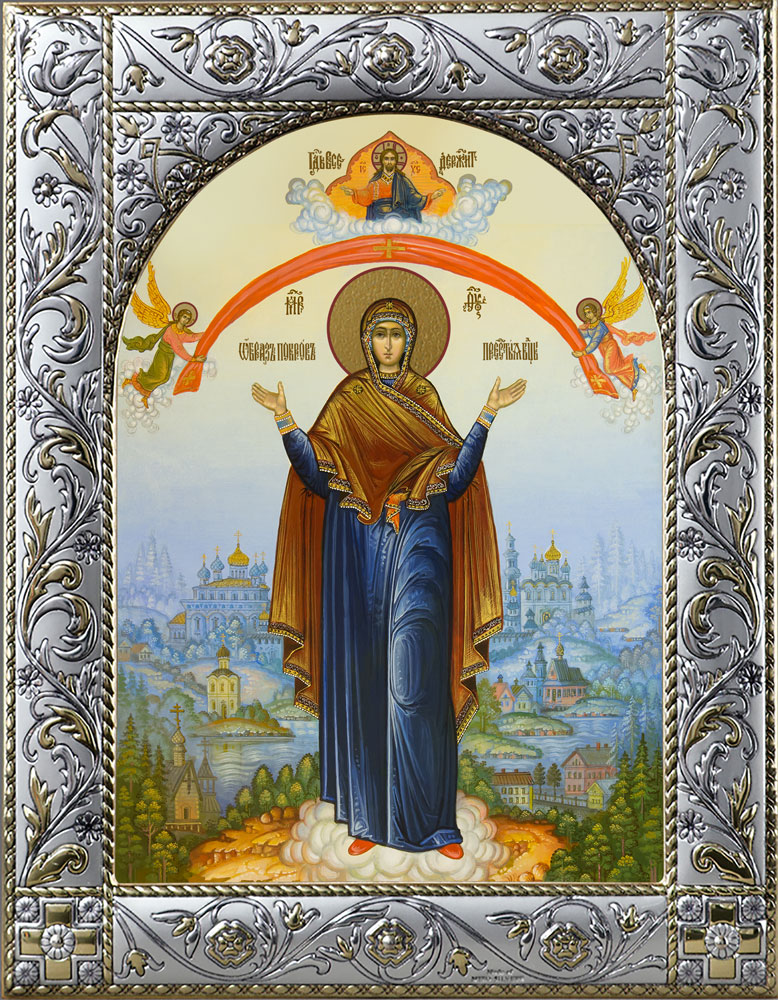
October 14 The Intercession of the Holy Mother of God and the Assumption of MaryThe feast of the Intercession was based on an important event in the history of Byzantium, reflected in Greek hagiographic sources, in particular in the life of the foolish man of Constantinople, Andrew. However, this event was not included in Byzantine worship, and Byzantium did not have a feast of the Intercession. The feast of the Intercession of the Blessed Virgin Mary was established in Russia in the middle of the twelfth century thanks to Prince Andrew of Boholyubov, who reigned in Volodymyr and deeply honored his heavenly patron, St. Andrew the Fool. The introduction of this feast is recorded in the Prologue of the twelfth century. The life of St. Andrew was well known in Russia, and it was translated into Slavonic in the 11th century. The life describes how one day Andrew, coming to the Vlachernae church during prayer, saw the Blessed Virgin Mary standing in the air, holding her maforia (a veil, a cover) over all the faithful. Vlacherni is a neighborhood in the northwest of Constantinople, not far from the imperial palace, where the famous Church of the Blessed Virgin Mary, built by Emperor Leo the Great in 474, was located. This temple housed the robe and girdle of the Blessed Virgin Mary, found by Queen Helena during excavations in the Holy Land.  The Byzantines especially venerated the Blessed Virgin, who, through the prayers of the faithful, repeatedly defended Constantinople from enemy attacks. One of the most famous cases occurred during the reign of Emperor Heraclius (VII century), when, going to war, he entrusted the protection of the city to the icon of the Blessed Virgin Mary, and the Virgin Mary did not allow the enemies to enter the capital. In honor of this miracle, an Akathist was composed in which the Virgin is praised as “Invincible Governor.” There were many similar cases in Byzantine history. For example, in 860, when the Russian armies besieged Constantinople, Patriarch Photios took the Virgin’s robe to the Bosphorus after the all-night vigil, and a storm immediately broke out, sinking the Russian ships and saving the city. The miracle that became the basis for the feast of the Intercession took place in 910. During an all-night vigil in the church of Vlachernae, St. Andrew witnessed the apparition of the Blessed Virgin Mary with the heavenly host of saints. She prayed for the protection of the people, and then spread her mantle over the worshippers, enveloping them in her veil. This vision, which Andrew shared with his disciple Epiphanius, became a symbol of the protection of the Mother of God. Prince Andrew of Bogolyubov took this vision as a special sign for himself and for Russia. The establishment of the Feast of the Intercession symbolized the trust of the Russian land under the protection of the Holy Virgin. Since then, Russia has considered itself one of the earthly possessions of the Mother of God, and the feast of the Intercession has become one of the most beloved holidays in the nation. |