   
    |
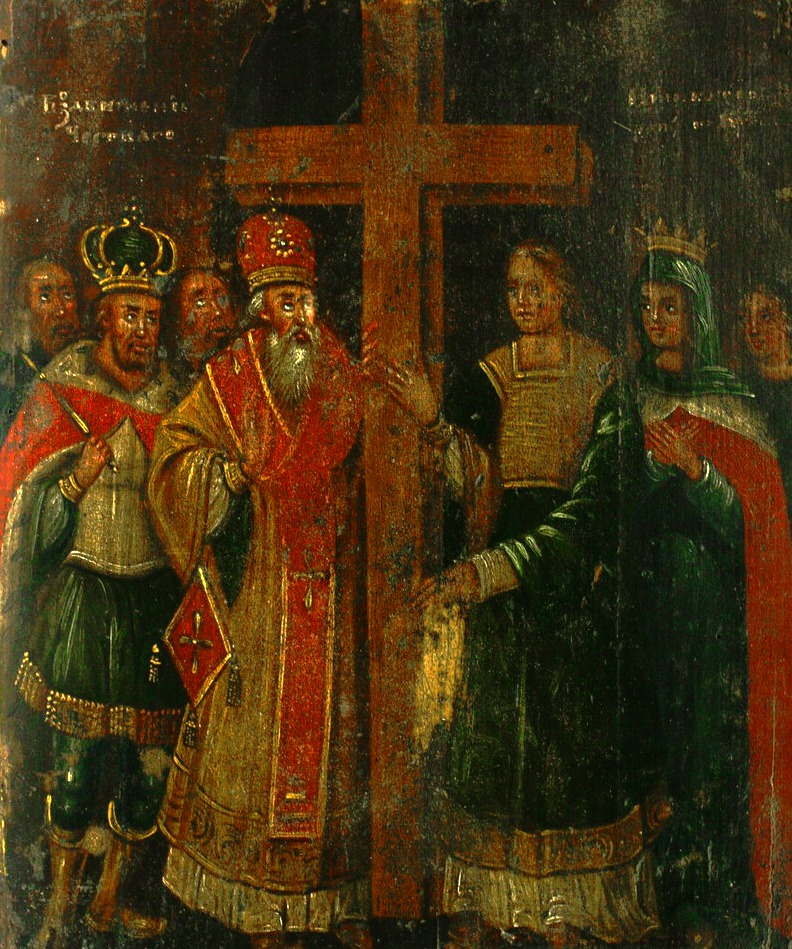
September 27 EXALTATION OF THE HONORABLE AND LIFE-GIVING CROSS OF THE LORDThe pagan Roman emperors tried to completely destroy the memories of the sacred places where our Lord Jesus Christ suffered for people and rose again. Emperor Hadrian (117-138) ordered the earth to be covered with Golgotha and the Holy Sepulcher and a temple to the pagan goddess Venus and a statue of Jupiter to be erected on an artificial hill. Pagans gathered at this place and performed idolatrous sacrifices. However, 300 years later, by the Providence of God, the great Christian shrines – the Holy Sepulcher and the Life-Giving Cross – were rediscovered by Christians and opened for worship. This happened under the Equal-to-the-Apostles Emperor Constantine the Great (Comm. May 21), the first Roman emperor to end the persecution of Christians. The Holy and Equal-to-the-Apostles Constantine the Great (306-337), after his victory in 312 over Maxentius, the ruler of the western part of the Roman Empire, and over Licinius, the ruler of the eastern part of the Roman Empire, in 323 became the sole ruler of the vast Roman Empire. In 313, he issued the so-called Edict of Milan, which legalized the Christian religion and ended the persecution of Christians in the western half of the empire. Although the ruler Licinius signed the Edict of Milan to please Constantine, he actually continued the persecution of Christians. It was only after his final defeat that the decree of 313 on religious tolerance was extended to the eastern part of the empire. The Equal-to-the-Apostles Emperor Constantine, who, with the help of God, won three wars and defeated his enemies, saw a sign of God in the sky – a Cross with the inscription “This is how you overcome.” Desiring ardently to find the Cross on which our Lord Jesus Christ was crucified, St. Constantine sent his mother, the pious Queen Helen (Comm. May 21), to Jerusalem, sending a letter to Patriarch Macarius of Jerusalem. Although the holy Queen Helen was already at an advanced age by this time, she took up the task with enthusiasm. The queen ordered the pagan temples and idol statues that filled Jerusalem to be destroyed. She asked Christians and Jews about the Life-Giving Cross, but for a long time her search was unsuccessful. Finally, she was pointed to an old Jew named Judas, who told her that the Cross was buried where a temple of Venus stood. The temple was destroyed and, after a prayer, they began to dig. Soon they discovered the Tomb of the Lord and, not far from it, three crosses, a tablet with an inscription made by order of Pilate, and four nails that pierced the Body of the Lord. To find out on which of the three crosses the Savior was crucified, Patriarch Makarii placed the crosses on the deceased one by one. When the Cross of the Lord was placed, the dead man came to life. When everyone saw the resurrected man, they were convinced that they had found the Life-Giving Cross. The Christians, who came in countless numbers to venerate the Holy Cross, asked St. Macarius to raise the Cross so that everyone could, albeit from a distance, piously contemplate it. Then the patriarch and other clergy began to raise the Holy Cross high, and the people, crying out: “Lord, have mercy,” and reverently worshiped the Honorable Tree. This solemn event took place in 326. Another miracle also occurred during the veneration of the Life-Giving Cross: a seriously ill woman was immediately healed when the Holy Cross was placed on her. Elder Judas and other Jews believed in Christ and were baptized. Judas received the name Cyriacus and was later ordained Bishop of Jerusalem. During the reign of Julian the Apostate (361-363), he was martyred for Christ (the memory of the Holy Martyr Cyriacus is on October 28). St. Queen Helen marked the places associated with the earthly life of the Savior by founding more than 80 churches built in Bethlehem, the place of the Nativity of Christ, on the Mount of Olives, from where the Lord ascended to heaven, in Gethsemane, where the Savior prayed before His suffering and where the Mother of God was buried after the Assumption. St. Helen brought a part of the Life-Giving Tree and nails with her to Constantinople. The Equal-to-the-Apostles Emperor Constantine ordered the construction of a majestic and large church in Jerusalem in honor of the Resurrection of Christ, which contained both the Holy Sepulcher and Calvary. The temple was built for about 10 years. St. Helen did not live to see the church illuminated; she died in 327. The church was consecrated on September 13, 335. The next day, September 14, it was established to celebrate the Exaltation of the Holy and Life-Giving Cross. On this day, another event associated with the Cross of the Lord is commemorated – its return from Persia after 14 years of captivity back to Jerusalem. During the reign of the Byzantine Emperor Phocas (602-610), the Persian King Khozroi II defeated the Greek army in the war against the Greeks, sacked Jerusalem, and took the Life-Giving Cross of the Lord and the Holy Patriarch Zacharias (609-633) into captivity. The Cross remained in Persia for 14 years, and only during the reign of Emperor Heraclius (610-641), who, with the help of God, defeated Chosroes and made peace with the latter’s son, Sirois, was their shrine, the Cross of the Lord, returned to Christians. With great solemnity the Life-Giving Cross was brought to Jerusalem. Emperor Heraclius, wearing a royal crown and porphyry, carried the Cross of Christ to the Church of the Resurrection. Patriarch Zacharias walked next to the king. At the gate that led to Calvary, the emperor suddenly stopped and could not move on. The Holy Patriarch explained to the king that the Angel of the Lord was blocking his way, because the One who carried the Cross to Calvary to redeem the world from its sins made His way on the Cross in a humiliated form. Then Iraklius, taking off his crown and porphyry, put on simple clothes and brought the Cross of Christ into the temple without hindrance. In his homily for the Exaltation of the Cross, St. Andrew of Crete (Comm. July 4) says: “The Cross is lifted up, and all the faithful flock, the Cross is lifted up, and the hail triumphs, and the nations celebrate.” |