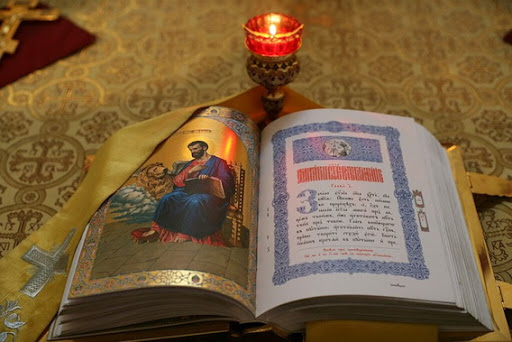
The Psalter is a book that is part of the Bible, consisting of 150 songs or “psalms”. It was composed by various authors (mostly King David) in Old Testament times.
The name “Psalter” is taken from the name of a stringed musical instrument resembling our psaltery or harp. To the accompaniment of the psalter (musical instrument) spiritual hymns (psalms) were sung.
In Hebrew the Psalter is called “tehillim”, i.e. “songs of praise”. The individual psalms are most often entitled “mizmor,” indicating musical accompaniment
The Psalter is divided into 20 parts, each called a “kafizma”. During the reading of a kafizma, one is allowed to sit (unlike the akathist). Each kafizma is divided into 3 parts, called “slavas”. After the first and second glory in each kafizma, a prayer for health can be added, and after the third glory, a prayer for repose.
All psalms can be divided into 4 types: psalms of praise, psalms of petition, psalms of thanksgiving to God, and a mixed form.
According to the Church’s Statutes, the Psalter is recited in its entirety in the divine services of the week, and during the Great Lent – twice a week.
Today the Psalter is published both in the Church Slavonic language (as it is read in the temple at the divine service) and in Russian, so that modern Christians can more easily understand the meaning of the Psalms.
Our Lord Jesus Christ Himself sang psalms. From the age of 12 He accompanied His parents to Jerusalem for the Passover pilgrimage of the Jews. On the journey from Nazareth to Jerusalem, the pilgrims sang psalms of ascent ( Psalms 119-133). The Gospel says that after the Last Supper, the Lord sang psalms with His disciples on the way to the Garden of Gethsemane.
As we know, the main psalmist (author of psalms) is the holy King David, who lived about 1000 years before Christ. Of the 150 psalms that make up the Psalter, 73 psalms (according to the Hebrew text) or 84 psalms (according to the Greek text) were written by him.
The author of the twelve psalms (Ps. 49, 72-82) was the psalmist Asaph, a contemporary of King David. He belonged to the house of Kore. Some psalms were composed later, so we can speak of a succession of the family. Psalm 88 is attributed to Haman, Asaph’s brother, and Psalm 89 to Ephan. All of these psalmists were members of the tribe of Levi and probably belonged to the same family union.
The author of Psalm 89 is believed to be the prophet Moses, and Psalm 71 is attributed to King Solomon.
In some psalms there are prophecies about the Messiah, which were exactly fulfilled during the earthly life of Jesus Christ
In the first centuries, Christians were encouraged by the singing of psalms to feats of piety, and psalms sustained them in the days of persecution.
In some psalms one can find the cursing of enemies. This often confuses the Orthodox Christian, for it seems contrary to the spirit of the Gospel. It should be remembered that these psalms were written in the times of the Old Testament, when the Saviour had not yet come into the world and made the Great Sacrifice for the sins of men. The relationship between people and God was somewhat different then, so militia against enemies was not strange for Old Testament times. Today we Orthodox Christians, when reading such psalms, need to imagine our own sins as our enemies. These are our internal enemies against whom we must militate. We should not hate the sinner, but evil and sin.
The Psalter was translated into the Slavonic language in the IX century by the Equal Apostles Cyril and Methodius from the Greek church text.
The recitation of the Psalms forms a major part of every divine service in an Orthodox church. Many psalms are recited in their entirety (for example, in the Sixth Psalm), and in other parts of the divine service parts of the psalms are used.
In Russia, the Psalter became the favourite reading of the Russian people and the main study book. The Psalter was used to learn literacy, and a person who had studied the Psalter was considered “bookish,” that is, literate. Russian people did not part with the Psalter. The book was read not only at home, but was taken with them on journeys for prayer and edification. The Psalms were read over seriously ill people, and the Psalms were also read especially for the dead (this tradition is still alive today). In many women’s monasteries the reading of the so-called “unsleeping Psalter” is performed, that is, the continuous reading of the Psalms.
“The Psalm is the silence of the soul, the dispenser of peace; it comforts rebellious and agitated thoughts; it softens the irritability of the soul and mortifies intemperance. The Psalm is the mediator of friendship, the unity between the distant, the reconciliation of the hostile. “